
Table of Contents
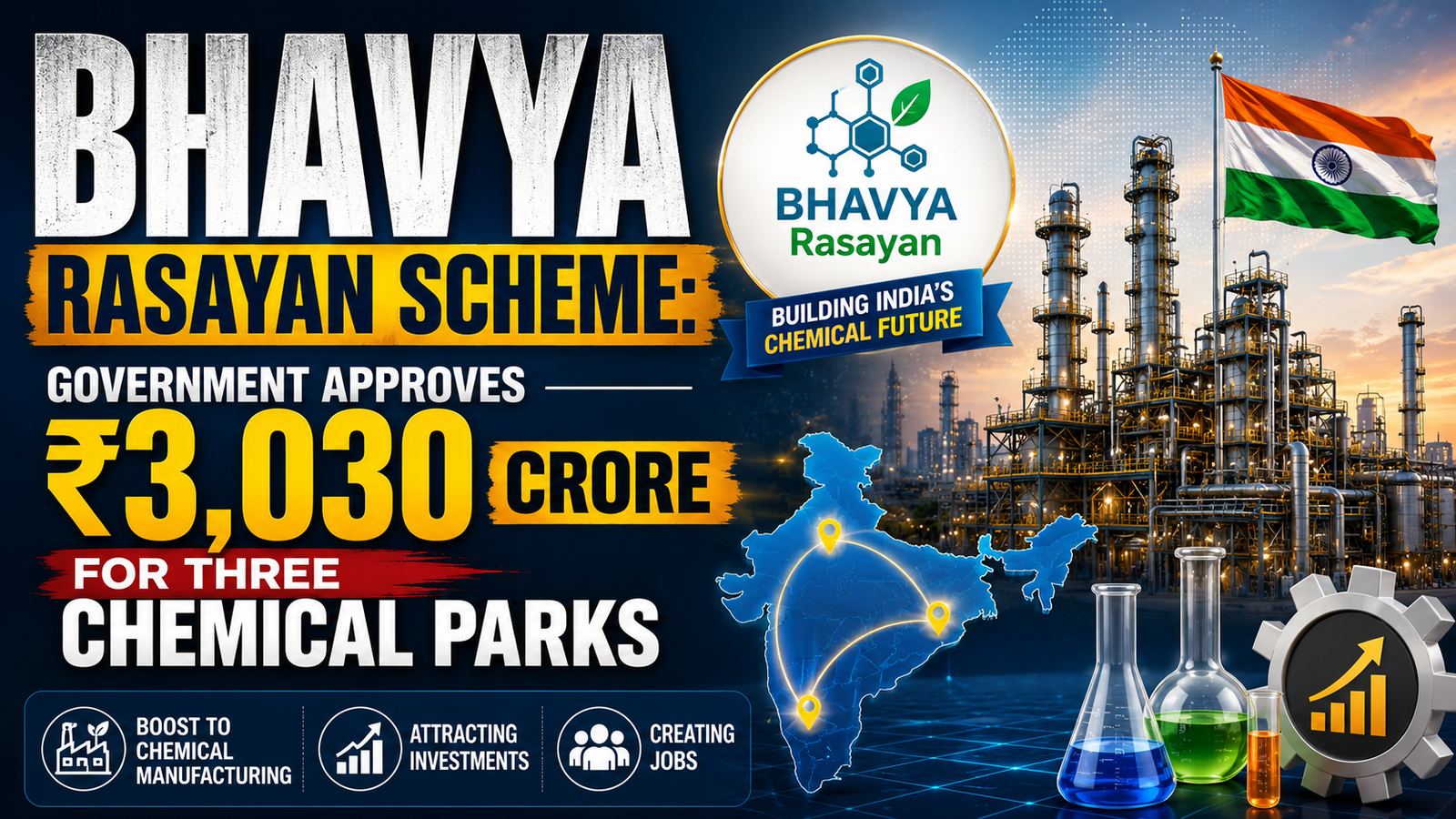
BHAVYA Rasayan Scheme: Government Approves ₹3,030 Crore for Three Chemical Parks
BHAVYA Rasayan Scheme has received government approval with a total outlay of ₹3,030 crore to support the development of three dedicated Chemical Parks across India.
The scheme is aimed at creating modern industrial clusters with integrated infrastructure, helping chemical manufacturers access common facilities and reducing the cost and complexity of setting up production units.
The move is expected to strengthen India’s domestic chemical manufacturing capabilities and support the country’s broader push for industrial development and self-reliance.
What Is the BHAVYA Rasayan Scheme?
The BHAVYA Rasayan Scheme is a government initiative focused on developing dedicated Chemical Parks with integrated infrastructure.

Instead of individual companies having to establish every supporting facility on their own, the parks are expected to provide common infrastructure that can be shared by multiple chemical manufacturers.
This approach can make industrial operations more efficient and create a stronger ecosystem for chemical production.
₹3,030 Crore Outlay for Three Chemical Parks
The government has approved an outlay of ₹3,030 crore for the development of three Chemical Parks under the scheme.
The investment represents a major push towards building specialised industrial infrastructure for the chemical sector.
Dedicated parks can help companies benefit from shared facilities, better connectivity and an organised industrial environment.
The initiative could also make it easier for new manufacturing units to enter the sector.
Why Chemical Parks Are Important
Chemical manufacturing requires specialised infrastructure, utilities, waste-management systems, transportation facilities and safety arrangements.
Developing these facilities within dedicated industrial parks can help companies avoid duplicating expensive infrastructure.
A well-developed Chemical Park can also encourage companies from different parts of the chemical value chain to operate in close proximity.
This can create efficiencies in sourcing, production, logistics and distribution.
Boost to India’s Chemical Industry
The BHAVYA Rasayan Scheme is expected to support India’s chemical industry by improving the infrastructure available to manufacturers.
India has a large and diverse chemical sector covering products used in pharmaceuticals, agriculture, textiles, automobiles, construction, consumer goods and several other industries.
Better industrial infrastructure could help domestic manufacturers expand their capacity and become more competitive.
The scheme could also support the development of downstream industries that depend on chemical inputs.
Focus on Integrated Infrastructure
One of the important features of the scheme is its focus on integrated infrastructure.
Chemical manufacturing facilities require reliable access to utilities and specialised services. Shared infrastructure can reduce the burden on individual companies and make industrial operations more streamlined.
Integrated parks can also help improve coordination between manufacturers and supporting service providers.
This could ultimately contribute to faster project development and more efficient manufacturing.
Potential Benefits for Manufacturers
Companies operating within the proposed Chemical Parks could potentially benefit from several advantages.
These may include access to common infrastructure, improved logistics, shared utilities and a more organised regulatory and industrial environment.
For smaller manufacturers and new businesses, such infrastructure could lower some of the initial barriers associated with establishing chemical production facilities.
Larger companies could also benefit from the ability to expand operations within an established industrial ecosystem.
Support for Domestic Manufacturing
The BHAVYA Rasayan Scheme comes at a time when India is focusing heavily on strengthening domestic manufacturing.
Reducing dependence on imports for critical industrial inputs has become an important part of India’s broader manufacturing strategy.
A stronger domestic chemical industry can support multiple sectors that rely on chemical raw materials and intermediates.
The development of dedicated Chemical Parks could therefore have benefits beyond the chemical sector itself.
Potential Impact on Investment
The creation of specialised industrial clusters could make the sector more attractive to both domestic and international investors.
Investors typically look for reliable infrastructure, supply-chain connectivity and access to supporting facilities when evaluating manufacturing projects.
Dedicated Chemical Parks can provide these advantages within a structured industrial ecosystem.
The ₹3,030 crore government outlay could therefore help create conditions for additional private-sector investment.
Employment and Economic Activity
Large industrial projects can also generate employment opportunities.
The development and operation of Chemical Parks can create jobs across manufacturing, engineering, logistics, maintenance, research and other supporting services.
As companies establish production facilities within the parks, additional economic activity could develop around the industrial clusters.
Local businesses may also benefit from increased demand for transportation, services and other industrial requirements.
Strengthening the Chemical Supply Chain
India’s chemical sector is closely connected with several important industries.
Pharmaceuticals, agriculture, plastics, textiles, paints, automobiles and construction all depend on various chemical products and inputs.
Improving domestic chemical manufacturing infrastructure could make these supply chains more resilient.
The BHAVYA Rasayan Scheme could therefore play a role in strengthening the availability of chemical products within India.
What the Scheme Means for India’s Manufacturing Goals
The development of three dedicated Chemical Parks represents another step towards building large-scale manufacturing ecosystems.
Rather than focusing only on individual factories, industrial cluster models can bring multiple companies and supporting facilities together.
This can improve efficiency and potentially reduce costs across the manufacturing value chain.
For India, such infrastructure is important as the country seeks to increase its manufacturing capacity and strengthen its position in global supply chains.
What Happens Next?
Following the approval of the BHAVYA Rasayan Scheme, the focus will move towards implementation and the development of the three proposed Chemical Parks.
The success of the initiative will depend on factors such as infrastructure development, private-sector participation, project execution and the ability to attract manufacturers.
If implemented effectively, the parks could become important hubs for India’s chemical manufacturing ecosystem.
Why the ₹3,030 Crore Investment Matters
The ₹3,030 crore allocation demonstrates the government’s focus on creating specialised infrastructure for an industry that supports a wide range of economic activities.
The Chemical Parks could help reduce infrastructure gaps, encourage investment and improve manufacturing efficiency.
For India’s chemical industry, the initiative could provide a foundation for future expansion while supporting the country’s wider manufacturing ambitions.
Frequently Asked Questions (FAQs)
1. What is the BHAVYA Rasayan Scheme?
The BHAVYA Rasayan Scheme is a government initiative aimed at developing three dedicated Chemical Parks with integrated infrastructure to support India’s chemical manufacturing sector.
2. How much has the government allocated for the scheme?
The government has approved an outlay of ₹3,030 crore for the development of three Chemical Parks.
3. How many Chemical Parks will be developed?
The scheme is designed to support the development of three dedicated Chemical Parks.
4. Why are Chemical Parks important?
Chemical Parks can provide shared infrastructure, utilities, logistics and other facilities, helping manufacturers reduce costs and operate within an integrated industrial ecosystem.
5. How can the BHAVYA Rasayan Scheme help India’s chemical industry?
The scheme can support domestic manufacturing, improve industrial infrastructure, attract investment and strengthen chemical supply chains.
6. Will the scheme benefit other industries?
Yes. Many sectors, including pharmaceuticals, agriculture, textiles, automobiles, construction and consumer goods, depend on chemical products and raw materials.
7. Can the Chemical Parks attract private investment?
The availability of integrated infrastructure could make chemical manufacturing projects more attractive to private investors and companies looking to expand their operations.
8. Could the Chemical Parks create jobs?
The development and operation of the parks could generate employment across manufacturing, engineering, logistics, maintenance and supporting services.
9. What is the main objective of the BHAVYA Rasayan Scheme?
The main objective is to create dedicated, integrated infrastructure that can strengthen India’s chemical manufacturing ecosystem and support industrial growth.
10. What happens after government approval?
The next stage will involve implementation of the scheme and development of the three Chemical Parks, along with efforts to establish the required infrastructure and attract participating industries.

