
Table of Contents
Founder Debt Restructuring: Byju Raveendran Proposes Aakash Shares Transfer to Settle Qatar Claim
The latest Founder Debt Restructuring proposal involving Byju Raveendran could bring a fresh development to the long-running financial and legal troubles surrounding the education technology entrepreneur.
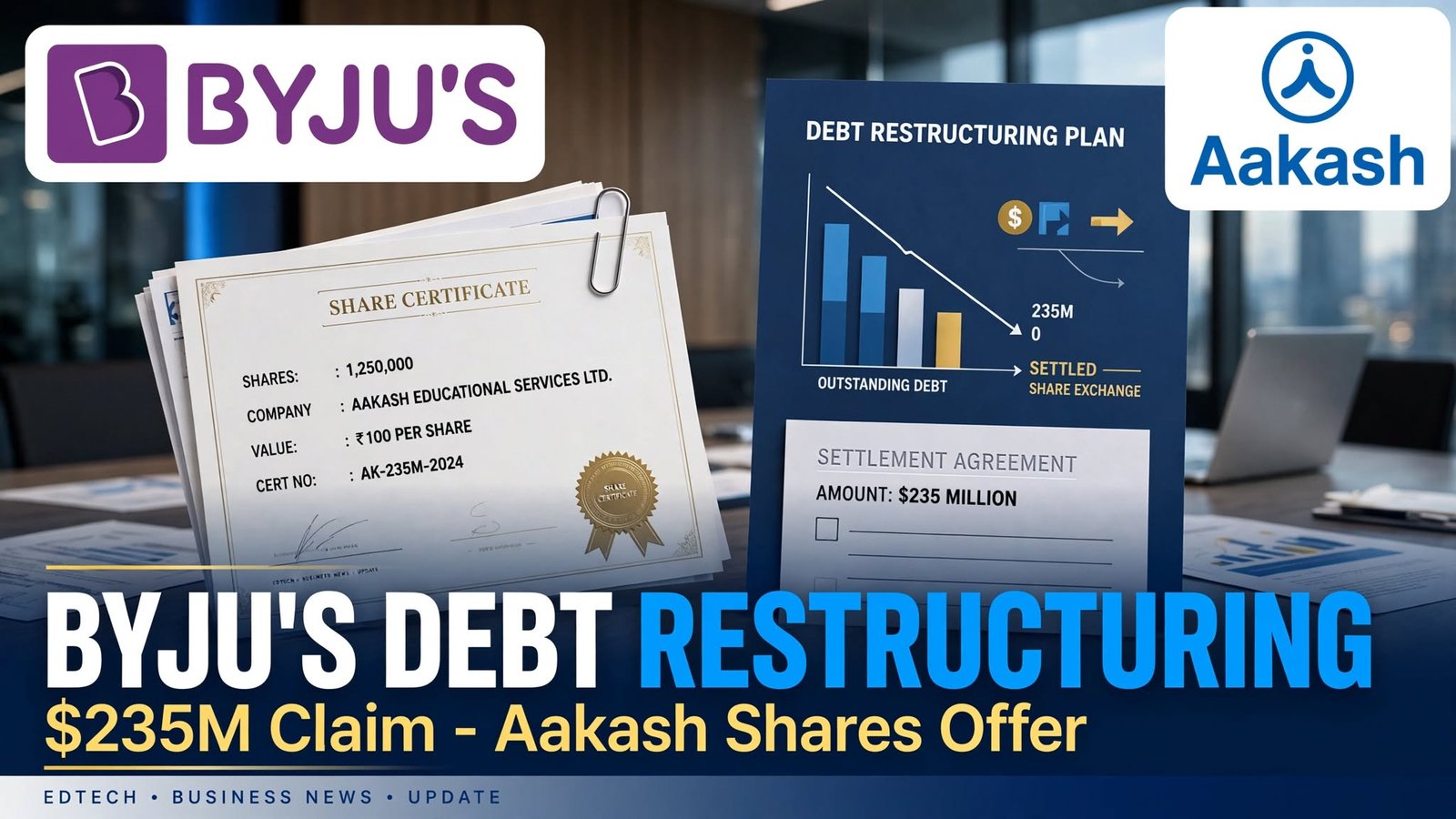
Raveendran has reportedly submitted a formal proposal to transfer 17.89 million shares of Aakash Educational Services as part of an effort to settle an ongoing $235 million arbitration claim by Qatar Holding.
The proposal places shares in one of the most valuable education assets associated with the Byju’s ecosystem at the centre of negotiations over the disputed financial obligation.
Byju Raveendran Offers Aakash Shares
The proposed transfer of 17.89 million Aakash Educational Services shares represents a significant component of Raveendran’s latest attempt to address the dispute.

Rather than relying solely on a cash repayment, the proposal would use an equity interest in Aakash as part of the settlement structure.
The move could potentially provide Qatar Holding with an asset linked to the education business while helping Raveendran address one of the major financial claims connected to the wider Byju’s crisis.
However, a proposal does not automatically mean that a settlement has been completed. The terms would still need to be accepted and implemented by the relevant parties.
What Is the Qatar Holding Claim?
Qatar Holding has been involved in an arbitration dispute connected to financial obligations involving Byju Raveendran.
The claim is valued at approximately $235 million, making it one of the significant financial disputes surrounding the entrepreneur.
Arbitration proceedings can take considerable time, particularly when large financial obligations and corporate assets are involved.
The latest share-transfer proposal indicates an attempt to move the dispute toward a potential resolution through an asset-based settlement.
Why Aakash Shares Matter
Aakash Educational Services is an important education business within the broader Byju’s ecosystem.
The company operates in the test-preparation and coaching segment, giving it a business model that is different from many purely digital education platforms.
Aakash’s physical learning centres and established presence in the test-preparation market make its equity potentially valuable as part of a restructuring or settlement discussion.
For creditors or claimants, receiving shares in an operating education company could provide a potential pathway to recover value without requiring the immediate payment of the entire claim in cash.
A Different Approach to Debt Settlement
The Founder Debt Restructuring proposal illustrates how large financial disputes can involve more than straightforward cash repayments.
When a company or individual faces substantial obligations, assets such as equity holdings can sometimes become part of negotiations.
Such arrangements depend heavily on the value of the underlying asset, ownership rights, restrictions on transfers and the willingness of creditors to accept the proposed structure.
In this case, Aakash shares are being positioned as a potential settlement asset.
Byju’s Financial Crisis Continues
The development comes against the backdrop of the severe financial crisis surrounding Byju’s, once India’s most prominent edtech companies.
The company’s rapid expansion, acquisitions and fundraising had transformed it into one of the country’s best-known startups. However, financial and legal challenges later intensified, involving creditors, investors and other stakeholders.
The disputes have extended across multiple jurisdictions and have involved questions around debt obligations, corporate control and asset ownership.
Raveendran’s latest proposal is therefore part of a much larger effort to address the financial fallout associated with the Byju’s ecosystem.
Potential Benefits of an Equity-Based Settlement
An equity-based settlement could offer advantages if the parties agree on an appropriate valuation.
For the claimant, receiving shares could provide exposure to a functioning education business rather than waiting indefinitely for a cash recovery.
For Raveendran, transferring shares could potentially reduce pressure associated with the outstanding claim while avoiding the immediate need to raise a very large amount of cash.
However, the final value of the arrangement would depend on the agreed valuation of the shares and the conditions attached to the transfer.
Questions Around Valuation
One of the most important issues in any share-based settlement is valuation.
The number of shares alone does not determine whether the proposed settlement fully addresses a $235 million claim. The underlying value assigned to those shares, along with any restrictions or conditions, would be crucial.
The parties would therefore need to agree on how the Aakash stake is valued and how that value is applied against the outstanding arbitration claim.
This makes the final settlement terms particularly important for understanding the financial impact of the proposal.
What Happens Next?
The immediate focus will be on whether Qatar Holding accepts the proposed structure and whether the parties reach a legally binding settlement.
If accepted, the transfer process would involve the necessary corporate and legal procedures governing ownership of Aakash shares.
If negotiations do not result in an agreement, the arbitration claim could continue through the relevant legal process.
Therefore, the current development should be viewed as a proposed restructuring step rather than confirmation that the dispute has been fully resolved.
Aakash at the Centre of the Dispute
The proposed use of Aakash shares also highlights the importance of the education company within the broader Byju’s story.
Aakash has maintained a significant presence in India’s test-preparation market, and its business assets have become particularly relevant as stakeholders examine ways to recover value from the wider Byju’s ecosystem.
The potential transfer could therefore have implications beyond the immediate arbitration dispute.
Key Takeaway
The latest Founder Debt Restructuring proposal sees Byju Raveendran offering 17.89 million Aakash Educational Services shares as part of an effort to settle Qatar Holding’s $235 million arbitration claim.
The proposal represents an asset-based approach to resolving a major financial dispute. Its outcome will depend on Qatar Holding’s response, the valuation assigned to the Aakash shares and the final legal terms of any settlement.
For now, the proposal marks another significant development in the continuing financial and legal challenges surrounding the Byju’s ecosystem.
FAQs
1. What is the latest Founder Debt Restructuring proposal?
Byju Raveendran has submitted a proposal involving the transfer of 17.89 million Aakash Educational Services shares to address Qatar Holding’s $235 million arbitration claim.
2. How much is Qatar Holding’s claim?
The arbitration claim is valued at approximately $235 million.
3. Which shares has Byju Raveendran proposed transferring?
The proposal involves 17.89 million shares of Aakash Educational Services.
4. Why are Aakash shares important?
Aakash is a significant education business associated with the Byju’s ecosystem and operates in India’s test-preparation market.
5. Does the proposal mean the debt has been settled?
No. A proposal is not the same as a completed settlement. The relevant parties would need to agree to the terms and complete the required procedures.
6. What is an equity-based debt settlement?
It is an arrangement where shares or another ownership interest in a business are transferred to a creditor or claimant instead of, or alongside, a cash repayment.
7. Why might Byju Raveendran use shares instead of cash?
Using shares could potentially help address a large financial obligation without requiring an immediate cash payment of the full amount.
8. What will determine the value of the proposed settlement?
The valuation of the Aakash shares and the specific terms agreed between the parties will be important factors.
9. Is the Qatar Holding dispute part of the wider Byju’s crisis?
Yes. The dispute forms part of the broader financial and legal challenges surrounding the Byju’s ecosystem.
10. What happens if Qatar Holding rejects the proposal?
If no settlement is reached, the arbitration claim could continue through the applicable legal process.

